The AI Transformation Operating Model
Building the future-ready organization — not just the AI team
A 5-minute read.
Value Proposition
- Transformation is the vehicle toward a defined business outcome, not the destination itself.
- Budget funds the outcome, not the transformation.
- Domains move together — each at its own pace, never sequentially — all pointed at the same goal.
- Long-term products, not short-term pilots: people adopt products, not POCs.
- Controls, security, and legal are lifecycle partners, not a gate at the end.
- Decision rights are explicit — AI and related decisions belong to named owners and sponsors.
- Infrastructure — cloud and compute — is planned in as a main player, not an afterthought.
- Architecture is designed for the type of AI in play — predictive, generative, and agentic each get the pattern they need.
- Data readiness is defined by the use case, not a generic cleanliness bar.
- Value is measured against the goal, continuously — not once at kickoff.
Core Principle
“An AI transformation” isn’t one contained initiative — one budget line, one owner, one timeline. It’s several old, familiar transformations — data, cloud, digital, product, business — converging and happening at once, because AI forces them to. Plus a human transformation most operating models ignore entirely: the people doing the work, and the people buying what gets built, are human. A plan that solves every tangible problem while ignoring chaos, resistance, and fear gets blocked anyway — not because the technology failed, but because nobody accounted for the real weight of asking people to work differently.
There is no transformation for its own sake. The goal is a specific business outcome, set at the start and tracked continuously — this operating model is the vehicle that delivers it, not the destination itself.
And this isn’t a call to rip out and rebuild. Every domain here — data, cloud, product, governance — already exists in some form in most organizations. The work is reorganizing how those pieces operate together, not replacing them. Most of what’s broken isn’t missing infrastructure. It’s infrastructure running as disconnected workstreams instead of one coordinated one.
Approach
Together, these sections show how the organization’s domains align around a shared business outcome and move forward as a coordinated team rather than as isolated initiatives. They connect synchronized sequencing and shared strategy ownership to three continuous workstreams: alignment and prioritization, structuring, and convergence and execution.
- The domains
- Sequencing — team sport, not a relay
- Strategy and execution, owned together
- Execution: one continuous thread, three time-boxed workstreams
The domains
Six tangible domains, one foundational layer running underneath all of them, converging on the human track at the center.
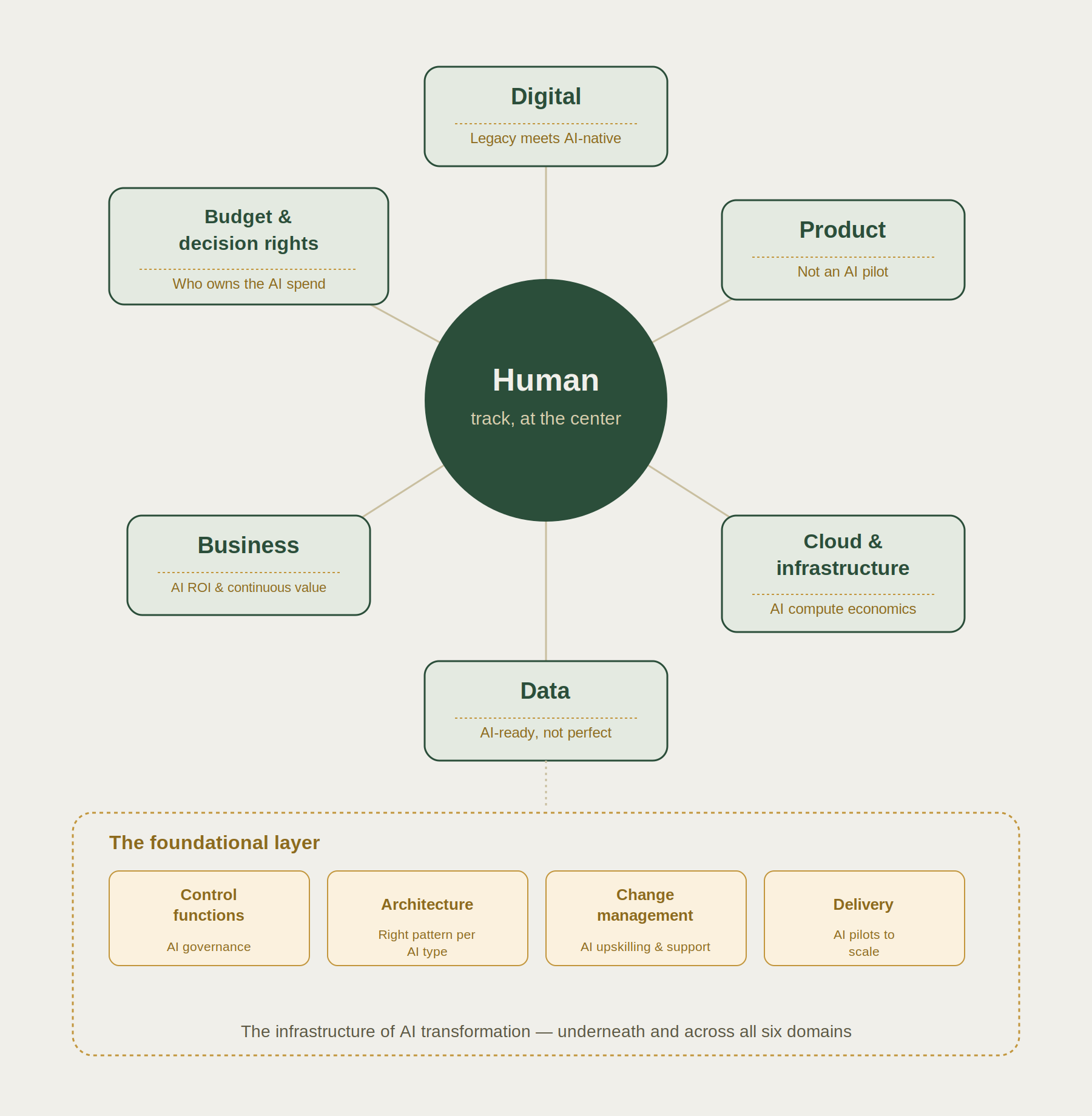
None of this is new — organizations have run each of these individually for a decade. What’s different with AI is that it forces several to converge at once instead of one at a time.
Two distinctions inside Data are worth getting right, because getting them wrong causes real over-investment in the wrong work. First: data readiness and data perfection aren’t the same thing — what counts as “ready” is defined by the use case, not a universal cleanliness bar. A fraud-detection model needs the unusual patterns a traditional data-quality program would filter out as anomalies. Second: a correctly-labeled example of a bad outcome isn’t bad data — it’s accurate data doing exactly its job. Confusing the two is a common, costly mistake.
Sequencing — team sport, not a relay
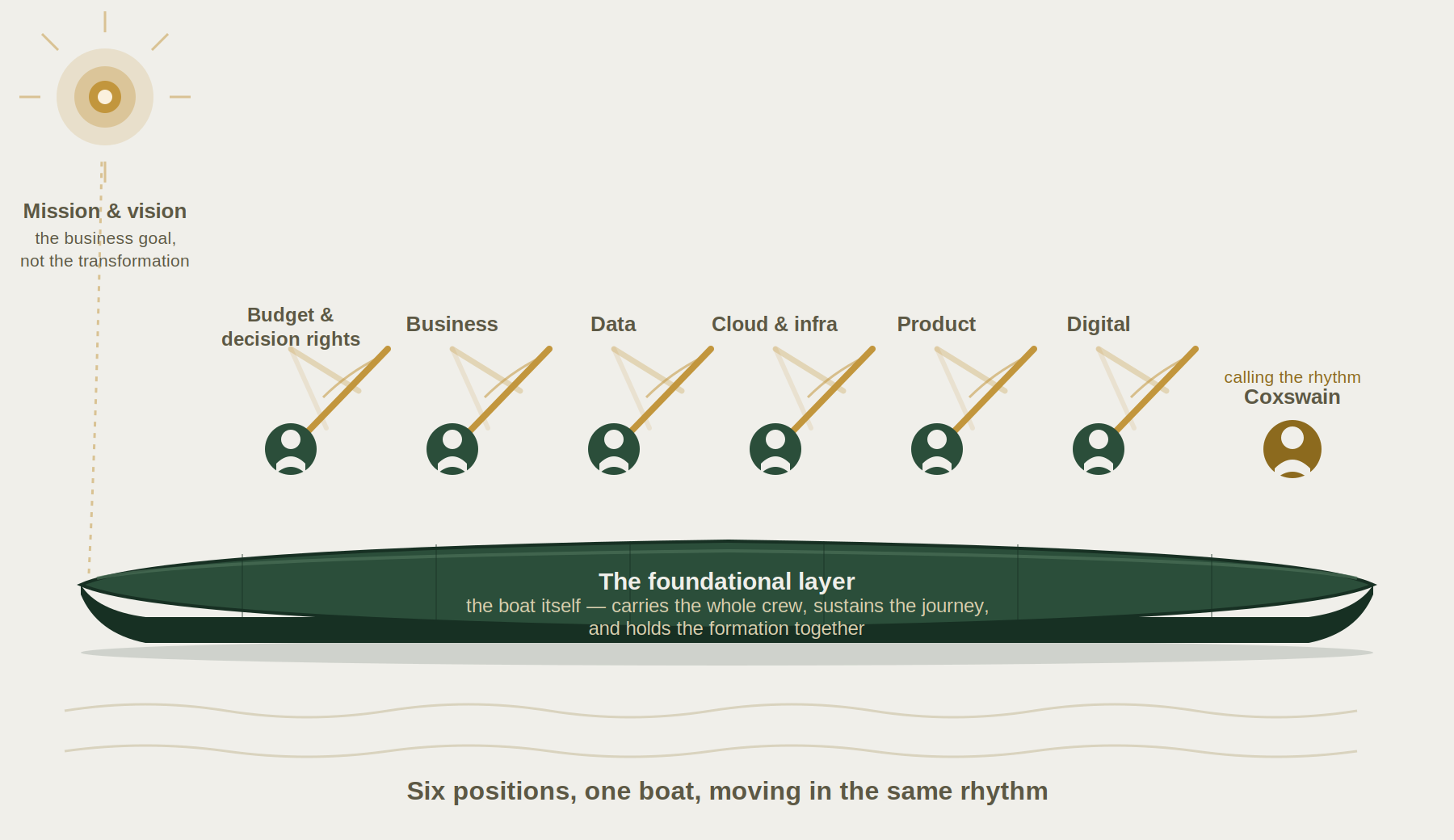
The instinct is to ask which transformation goes first. Wrong question. Every part of the organization gets ready to play simultaneously, so when a domain needs to lead, it’s already in position — not starting from zero.
Strategy and execution, owned together
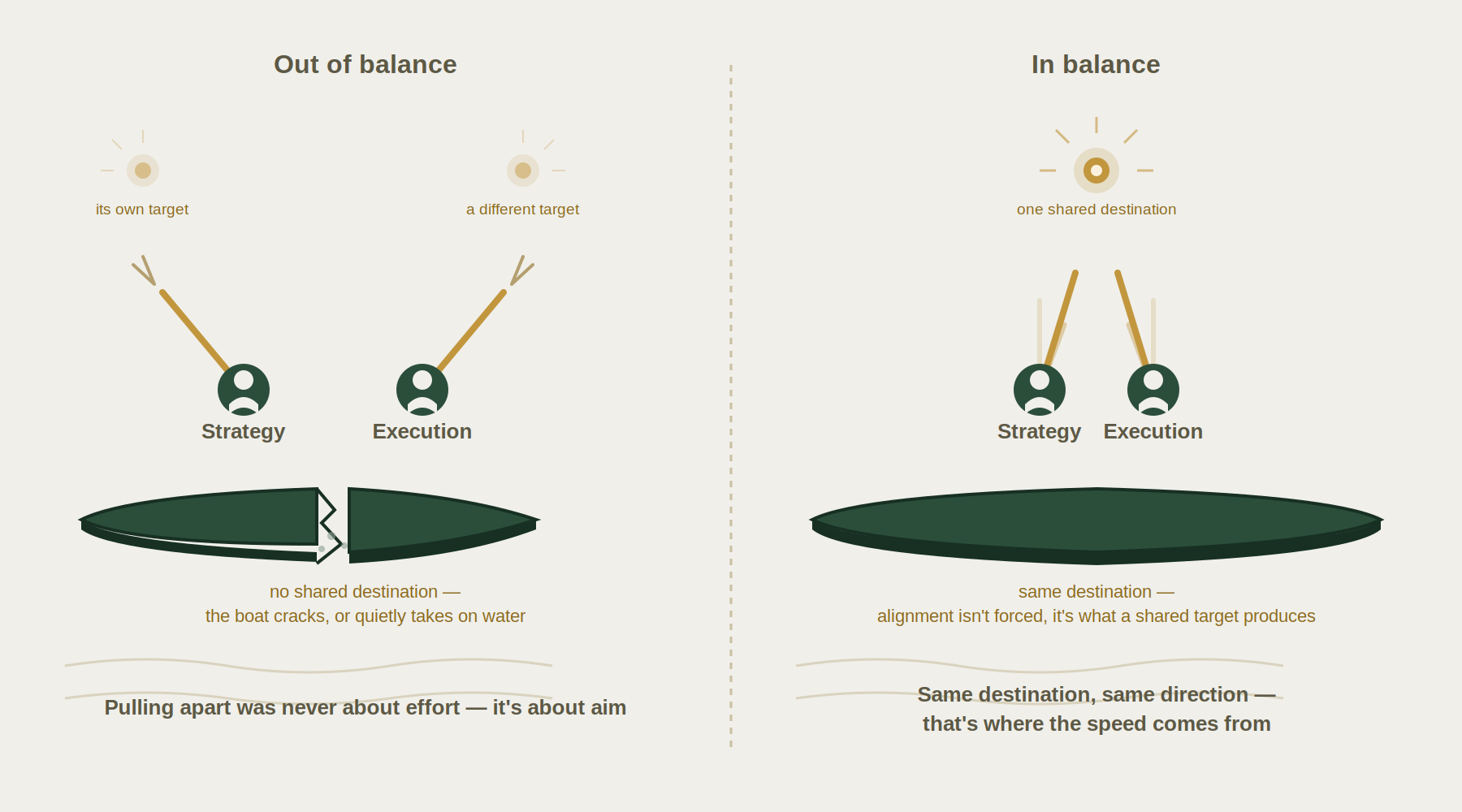
Splitting them across two firms — or two internal camps — is where most engagements quietly leak value. Whoever owns the strategy has to stay through delivery, because execution reshapes strategy in real time, not just the other way around.
Execution: one continuous thread, three time-boxed workstreams
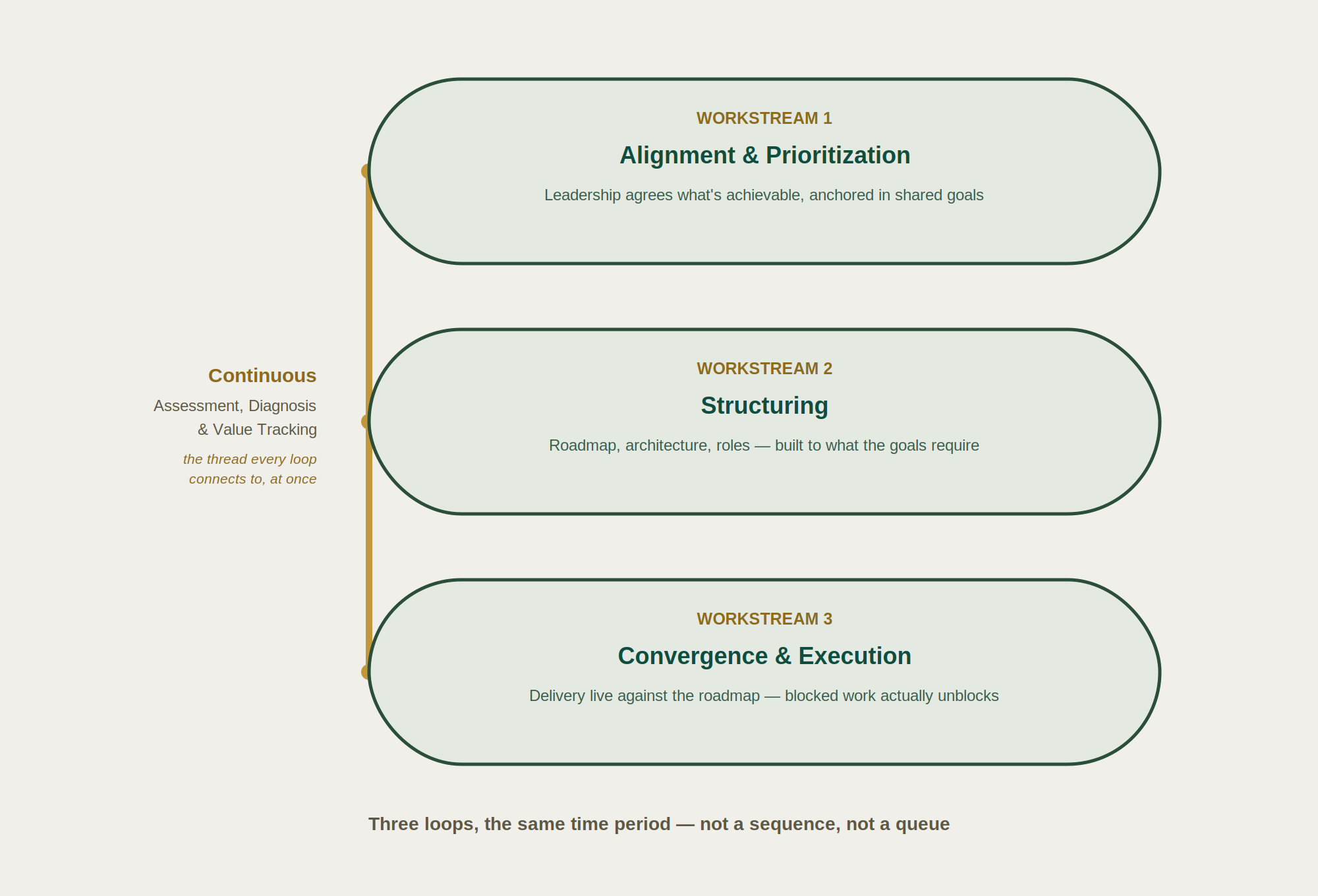
Assessment, diagnosis, and value tracking run underneath everything, the whole time — never a one-time kickoff exercise. On top of that: Alignment & Prioritization (real leadership agreement on what’s achievable, anchored in shared goals), Structuring (roadmap, architecture, and roles built to what those goals actually require), and Convergence & Execution (delivery live against the unified roadmap, leadership still steering, not handed off).
Where this applies:
- Multiple transformation initiatives already in flight,sharing systems or teams, without a shared plan.
- Budgets overflowing without a clear line to ROI.
- Leadership that agrees AI matters but hasn’t agreed what “done” looks like.
- Stalled initiatives quietly blocking what the organization was actually hired to deliver.
Proof
One organization was mid-way through a data transformation and a cloud transformation when the AI mandate started — not after, in the middle of both. Same systems, same teams, same clients, different ownership, different definitions of value. The full walkthrough — including the real root cause underneath the stated AI mandate — is in Case Study : Entangled Initiatives .
This model keeps being tested against new, entangled situations as they accumulate — it isn’t a one-time deliverable. What’s still open: named, self-diagnosable readiness stages a reader could use to place their own organization, and a clearer map of how this applies across advisory, owned delivery, and embedded partnership as distinct engagement shapes.